
I don’t tend to watch sports, however I did catch sight of the screen message shown at half time at the Sea Hawks v Patriots Super Bowl final recently. A very good friend is a huge fan and went to the US to watch it. The message was,
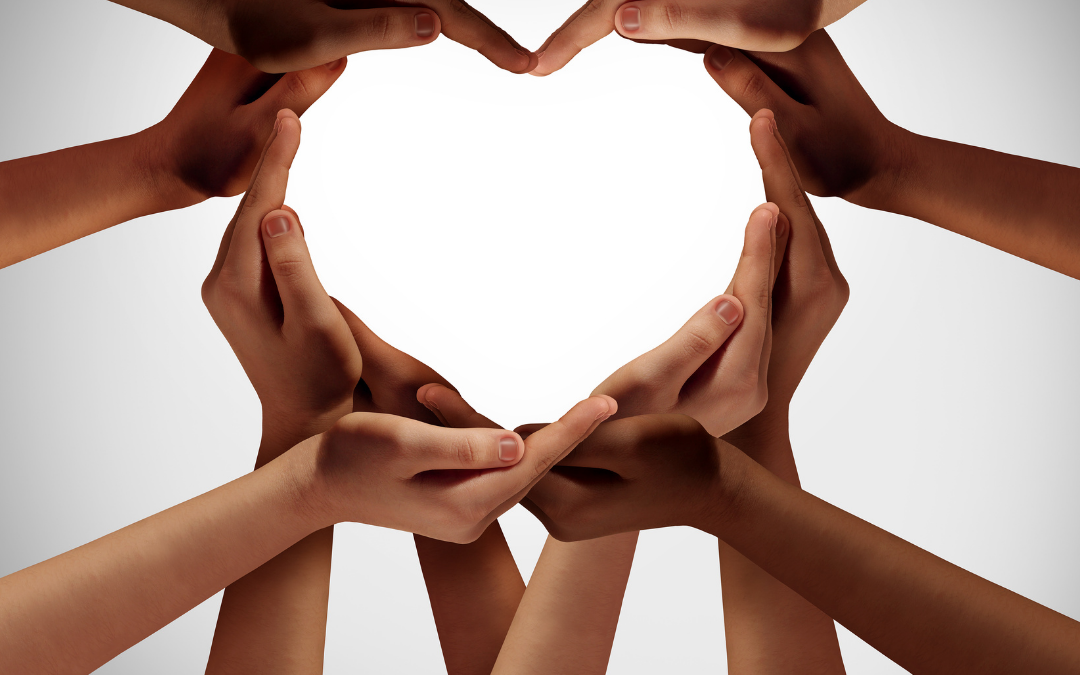
‘The only thing more powerful than hate is love’
I believe it is. When we get down to it, with love at our core – in our heart, we can dissolve hate. In that space curiosity can enter and we can connect and reconnect with others.
What’s Happening to Us?
Shocking revelations are being uncovered daily, which are reverberating around the world, many with repercussions in the UK.
The certainty and belief the majority of people had in our system and institutions, has decreased and in some quarters, crumbled entirely. The world feels increasingly volatile, uncertain, changing and ambiguous (VUCA), with trust seeming to be at an all-time low.
At times like these, it’s easy to feel unmoored and adrift, unsure who or what to rely on.
Nevertheless, life continues as it always has and does. Here we are in February, the month of love, with hearts and cards on the shelves. Commercialism aside, the need for love, kindness, and genuine human connection is paramount. Far from sentimentality, it’s a reflection of the irrefutable fact that we humans are wired for connection and relationships support longevity.
We’re social creatures by design, much as some might deny it. Our nervous system is regulated through relationships. We learn, grow, feel secure and find meaning in connection with others. When trust erodes at a wider societal level, our instinctive response is to look closer to home: to our personal relationships, to community and desire spaces where we feel seen, heard and valued. Very importantly – to focus on things we might be more able to trust.

The 6 Human Needs
Many years ago, Tony Robbins popularised the concept of the 6 human needs. Everyone has a combination of these in varying degrees.
Certainty and uncertainty
Certainty relates to safety and predictability. Uncertainty relates to growth and change. We function best when we have enough structure to feel safe and enough flexibility to remain alive and adaptive.
Significance and love
Significance reflects the need to matter and be recognised. Love the need for connection and belonging. Again we need both and for some one is far more important than the other.
Growth and contribution
These both relate to meaning and fulfilment. Growth supports personal development. Contribution creates shared purpose.
When we’re part of a community these needs can get fulfilled.
Historically, being part of community was intergral in our lives. The celebration of individualism and self sufficiency is relatively recentl. The church, the local high street, youth club, pub, community centre were all places we’d go out an meet. Children played out on the streets. Yes there were reasons we moved on, yet we’ve lost something along the way. Something many people seem to be yearning for.
Change is happening. There’s a growth of conscious communities around the country, with people living more communally, growing food and home educating their children. There are Millennials and GenZ who’ve grown up with phones and screens seeking out different group and community activities.
Within that, there are many who struggle to connect or communicate effectively, and in order to build, live and work together successfully, we could all do with brushing up on a few skills.
Which is where conscious communication and relating skills become essential, and where Neuro Linguistic Programming (NLP) offers a powerful and practical framework.

Connection as a Response to Uncertainty
It’s important to understand that uncertainty isn’t inherently bad. Everyone has a need for variety, challenge and change in some way or form at certain times of their life. Yet prolonged instability without grounding, can adversely affect wellbeing and increase anxiety, and have us become insular and hostile towards those we consider different to our tribe.
We all have differing tolerances for uncertainty. Therefore communities require awareness, flexibility and empathy to function well. Connection acts as a stabilising force. When people feel connected, uncertainty is more navigable. Shared experience creates continuity, even when external systems and structures feel unreliable.
NLP Helps Manage Uncertainty
NLP helps us understand how we process uncertainty internally as it brings awareness to thinking patterns, emotional responses and habitual behaviours, that either amplify fear or build resilience. When we understand how our mind and nervous system respond to change, we increase choice in how we show up around others. This self-regulation enables us to have calm, constructive conversations, make better decisions and build stronger relationships.
Connection Begins with Listening
That means being fully present, with genuine curiosity and a willingness to acknowledge and respect another person’s model of the world. Listening is central to effective communication. NLP develops skills for listening to build deep rapport, read the language of the body, adapt communication styles and use language elegantly for greatest effect.
We learn that the meaning of communication is the response we receive, which puts the responsibility squarely on our shoulders to be more adaptable and flexible in communcating. Trust grows when people feel genuinely heard and conversations move to meaningful dialogue.
NLP Develops Powerful Language Skills
This enables us to adapt our use words and phrasing, tone, pace and non-verbal cues to attune more accurately to each other. Differences disappear when communication is open, flexible and respectful.
NLP Increases Self-awareness
Our communication to ourselves is important and NLP helps us notice how our beliefs, internal dialogue and emotional states influence our behaviour. With that awareness comes choice in the way we can communicate to strengthen relationships.

What is Identity?
We’re all born as a fairly blank slate and with potential. We develop a core identity when we’re young, much of it before the age of 9 or 10. It’s constructed of beliefs about who we think we are; our qualities, abilities, skills and how we judge them, and how we see ourselves in the world. All this influences our experiences and the meaning we give them, our behaviours, our perception and thinking. It’s mutually reinforcing.
Our identity is our concept of who we are.
Our core beliefs create a consistent sense of who we are. They’re our internal GPS system that helps us feel grounded as we navigate life. There are many beliefs we hold in common with other people, like our social norms, rules and moral codes. These give society coherence, stability and a level of predictability.
Many people view their identity as unchanging and unchangeable. They believe traits are genetic or inherited and can’t be changed, despite neuroscience proving the brain has neuroplasticity.
The Fixed Mindset
You can hear it in how people talk about themselves: “I’ve always been like this”, “I’ve got an addictive personality”, “I’ve never been clever”, “I was born unlucky – it runs in the family”. You may well have your own version of this.
This is fixed mindset thinking. In NLP, we’d say you’re giving away your personal power. Change isn’t a possibility and beliefs are facts and immutable truths.
The good news is that they’re not. Beliefs are constructs we’ve created that we take to be true and we use them to frame our thinking, behaviour and our lives.
Have you ever questioned where your beliefs came from? Did you create them or were some absorbed unconsciously from others speaking about themselves or you? With the useful, helpful beliefs, all to the good. It’s those that are highly limiting that are disempowering, get in the way or keep us stuck.

Kindness as a Conscious Practice
Kindness is sometimes dismissed as soft, particularly in professional environments. Research and lived experience show otherwise. Random acts of kindness have measurable effects on wellbeing, emotional regulation and social bonding. The positive impact often lasts for days, influencing how we interact with others long after the initial gesture.
When we feel calm, valued and connected, we communicate more effectively and behave more generously. Small acts of kindness shift internal states, which in turn influence how we show up in community.
In organisations, networks and communities, kindness supports psychological safety. People feel safer to take risks, share ideas and recover more quickly from challenges. In uncertain times, these qualities become essential to meaningful connection.
Expanding the Meaning of Love
Love extends far beyond romance. It includes care, compassion and a genuine concern for the wellbeing of others. It shows up as respect, fairness and a willingness to contribute positively to shared spaces.
Humans need to feel connected and valued to function well. When these needs are unmet, behaviour becomes defensive, withdrawn or reactive. Understanding this creates compassion rather than judgement.
Love for self is equally important. Self-connection involves recognising one’s own needs, values and patterns. Learning NLP helps you explore how you motivate yourself, how you respond under pressure and what drives your decisions. With this awareness, you can communicate more clearly, set healthier boundaries and engage from a place of grounded confidence.
From Awareness to Collective Potential
At its core, NLP is an operating system that sits under everything and informs everything. When we become more aware of our thinking, language and emotional responses, the quality of our interactions improves and trust grows. When trust grows, community strengthens.
NLP supports the platinum rule, which is to treat others as they would like to be treated. This necessitates curiosity, flexibility and empathy. It moves relationships beyond projection into genuine understanding.
In a world where trust has been shaken and for many, feels fragile, connection is an anchor and our communication is the bridge. Community becomes the place where kindness and love are practised daily rather than reserved for special occasions.
NLP provides the skills to do this consciously: to listen more deeply, communicate more skilfully, regulate emotions more effectively and build relationships that are resilient in the face of change.
The invitation is simple: act with kindness, connect with intention and contribute generously. In doing so, we create stability, meaning and hope within an ever-changing world.
You can find out more about becoming an NLP Practitioner here.
If you enjoyed this blog, then please do share it on Linkedin, Facebook and Instagram.
Do connect with me on Linkedin, Facebook and Instagram
